A Genealogy Breakthrough Moment
Quick background on a genealogy breakthrough moment…
My Italian immigrant grandparents (Frank and Elizabeth) – who we all thought had died in the 1930s -- were actually committed to insane asylums, a fact that we did not discover until release of the 1940 Census. I began a long search to find out what happened to them, which eventually morphed into my book, Immigrant Secrets - https://www.amazon.com/Immigrant-Secrets-Search-My-Grandparents/dp/B0B45GTTPP.
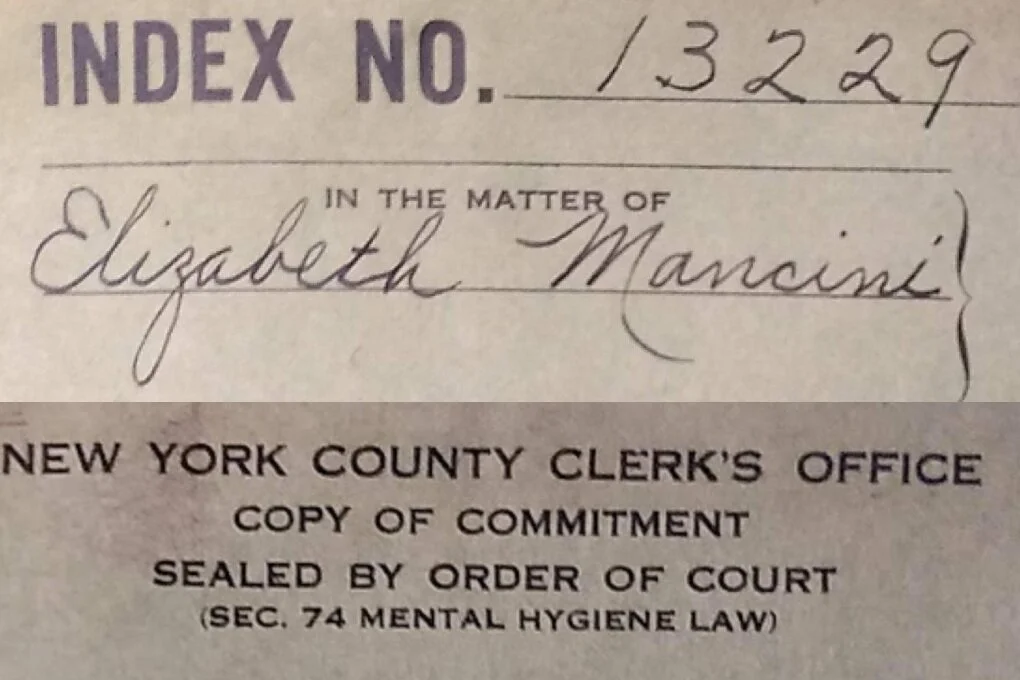
My initial search focused on health records – a complete waste of time – until I went down the path of LEGAL records. When I requested the 1932 court records for the commitment proceeding for my grandfather Frank, I also asked about my grandmother Elizabeth and discovered there were records for her commitment proceeding as well … record number 13229 from 1938.

After reviewing my grandfather’s commitment papers, I paused to contemplate what on earth happened between 1932 and 1938 to send my grandmother down the same path as her husband. I wondered who committed her. I wondered how my father survived it all. I had discovered so much of my grandfather’s story from my grandfather’s commitment record, but that was not to be the case with my grandmother.
All that was in her file was an envelope. Elizabeth’s name was written on the left in very nice handwriting. In the upper-right corner of the envelope were these words:
“New York County Clerk’s Office, Copy of Commitment, Sealed by Order of the Court, Section 74: Mental Hygiene Law.”
To make a long story short, this sent me down another long trail to figure out how to open this file, a trail that ultimately led nowhere. I was just about to decide that I would never know how and why she was committed.
And then I bit of serendipity.
I stumbled upon Libby Copeland’s book, Lost Family: How DNA Testing Is Upending Who We Are. It’s a great book. In the book, The New York Society for the Prevention of Cruelty to Children (https://nyspcc.org/) was a core source in solving a family history mystery involving two newborns who wound up with the wrong parents.
It struck me that if things had truly unraveled for my grandmother and her two sons, perhaps there might be some record of this with the Society. Perhaps someone had lodged a complaint or a concern, and someone from the Society had stopped by to investigate. Was there some record that I had yet to find that would provide some hint as to how or why Elizabeth was committed in 1938?
And this was my breakthrough moment in Elizabeth’s story.
There WAS a record – from 1938 – about my grandmother. A kind woman named Chelsea Frank helped me track it down, even though we were all in the middle of COVID.
Here is the record…
https://drive.google.com/file/d/1UqDc2PHwtmdSkmNokpxtrzdl535-qcG-/view
And here is what I found out…
The Initial Complaint
On March 21, 1938, Miss Priscilla Bourbonnais, a Board of Child Welfare employee, contacted the NYSPCC with grave concerns about the Mancini family living at 179 East 2nd Street in New York City. Elizabeth Mancini, a mother of two sons—Joseph (born May 25, 1925, my father) and Vincent (born February 11, 1928)—had been receiving assistance ($55 per month) from the Board of Child Welfare since her husband’s commitment in 1932. However, since January 1st of 1938, Elizabeth had refused to accept any checks from the Board.
Her justification for refusing aid was both heartbreaking and revealing -- she believed that accepting continued assistance would result in her husband’s continued incarceration at Rockland State. She believed that signing documents that she did not understand had led to her husband’s commitment, and that continuing to do so – even if she was only signing a welfare check – would lead to his continued incarceration. A worker visiting the residence reported being unable even to enter the home, suggesting either severe neglect or Elizabeth's unwillingness to allow intervention.
Miss Bourbonnais made a specific and urgent request: she wanted the Society to assist in having Elizabeth sent to Bellevue Hospital for psychiatric observation and possible commitment, as she believed from previous observations that the mother exhibited signs of serious mental illness. She also stated, though, that the children were well-fed and physically healthy but were clearly being affected by their mother's "strange behavior."
The Investigation Unfolds
The NYSPCC assigned an Officer Cuoco to investigate the case on March 21st. What he discovered painted a complex picture that would challenge the initial narrative. Upon visiting the premises at 179 East 2nd Street, Officer Cuoco met Elizabeth in her top-floor apartment. He found the living space clean and well-maintained, and Elizabeth herself presented as clean and coherent. Most significantly, four rooms in the apartment were kept immaculately—a detail that was important in assessing her mental state.
During questioning, Elizabeth stated she felt perfectly fine and had no complaints to make. Her refusal of financial assistance from the Board of Child Welfare stemmed from her exhaustion with being "annoyed by the various investigators"— a detail that suggests she may have felt overwhelmed by the constant scrutiny and intervention in her family's life. She believed that if she refused the aid, her husband would be released from Rockland State Hospital.
When questioned about where she obtained money to survive without the Board's assistance, Elizabeth stated she had saved "a little something" from previous allowances. She also said her son Joseph, now 12 years old, earned money shining shoes. Officer Cuoco noted that Elizabeth was determined not to sign any more papers because she felt that when she had been persuaded to sign the commitment documents for her husband, "it was a trick and that she is not going to be tricked into any further signing."
Officer Cuoco's initial assessment was measured—he was not yet entirely convinced she was mentally ill, though he acknowledged she seemed tired of being annoyed by investigators and stated she was determined not to cooperate further. At this point, Joseph came home from school. He was questioned about his mother's behavior, and he stated that his mother was afraid to sign any more papers because she felt that something else would happen. During the entire interview, which lasted over an hour, Elizabeth answered all questions rationally and coherently.
After leaving the apartment, the investigators heard yelling and screaming coming from the apartment. Elizabeth was threatening Joseph with an iron, and he was threatening to jump from the window unless she agreed to meet with the Board and accept the checks. After things calmed down, Joseph assured the Officer that he would see to it that his mother called for the checks. Officer Cuoco then asked what they had to eat, and Joseph stated hard boiled eggs and milk. He stated that his mother had never harmed him and he was not in any danger.
The Mother's Defiance
The case took a more confrontational turn as it progressed through April and May. Officer Cuoco's subsequent visits revealed Elizabeth's growing resistance to intervention. On April 18th, around 11:30 AM, another police officer, Officer Bothwell, called at the premises and found Elizabeth and her son Joseph at home. The apartment remained clean and in excellent condition, and the boy appeared well-dressed and apparently healthy.
When asked why she hadn't gone to the Board of Child Welfare to receive her checks as requested, Elizabeth stated that she didn't want any trouble and they would only make trouble for her if she went. She remained adamant that she was tired of various people annoying her. Officer Bothwell then informed her to go to the Children's Court on April 21st and handed her a slip of paper with the address of the Children's Court. She threw the slip of paper at the officer and slammed the door.
Escalation and Court Intervention
The situation escalated dramatically in her absence in Children's Court. The judge refused to issue a summons but directed the officer to get a written report from the Board of Child Welfare explaining why they believed the woman was insane and why they thought the children were neglected.
May 2nd, marked the most dramatic moment in the case. Officer Bothwell secured a summons for Elizabeth and her sons Joseph and Vincent to appear in Children's Court on May 5th. When he attempted to serve the summons, Elizabeth's refused to let the officer enter the home and told him multiple times "I ought to kill you." She refused to accept the summons and threw it at him. As the officer was going downstairs, she appeared on the floor above and tried to hit him over the head with a large stick.
The Final Resolution
On May 9th, Officer Bothwell appeared in Children's Court, and Justice Cobb issued a warrant for Joseph and Vincent. On May 10th, Joseph and Vincent were taken into custody. When informed about this at the local precinct, Elizabeth became hysterical and was subsequently removed to Bellevue Hospital where she was then confined.
Seven days later – after the commitment hearing documented within my sealed envelope – a Probation Officer reported that Elizabeth was about to be sent from Bellevue Hospital to Central Islip Asylum. And her children were paroled to relatives, never to see their mother again.