Brick Walls and Missing Links
Everyone in the family history business, whether amateur or professional, is familiar with brick walls —the point at which your search for a particular connection seemingly can go no further.
I faced an enormous family brick wall before beginning the research that would eventually lead to IMMIGRANT SECRETS. Specifically, my father never discussed his parents or any other relative except a cursory mention of an “Aunt Jennie” other than to say, “They came from Italy and died in the 1930s.” He passed away in 1987, and the brick wall remained.
It turned out to be a brick wall of our own making based on family secrets rather than a failure of records, one that would largely remain in place until the release of the 1940 census. We discovered that his parents DID NOT die in the 1940s but were very much alive and in a Rockland NY Asylum. Enter Ancestry.com, and brick by brick, parts of the wall came tumbling down. The real breakthrough in their story came with the realization that "discovering new records means looking in new places" – a phrase that deserves a shout-out to Amy Johnson Crow. This search for records in unusual places became the story that I reflected upon in my book and on my blog.
Looking back, when I started this journey, I was cavalier with documentation. Pro Tip: Don’t do this.
I also tended to get overly enamored with the wild abundance of user-generated content on Ancestry trees. I would click the hint leaves madly, find a public tree with my people on it, and add the information to my own tree. Pro Tip: Don’t do this.
I've since become much more disciplined in requiring documentation before adding anything and deleting anything that cannot be proven. However, I can still find vestiges of my earlier carelessness replicated in other public trees. Sorry about that.
That long prologue leads me to my wife's family and a particular brick wall that I have. Well, maybe not a brick wall, but certainly a “missing link” that I’m not quite willing to “certify” until I can find some documentation.
When I first met my future mother-in-law, Nancy, it became immediately apparent that my own family history was sorely lacking. My family tree only went back to immigrant grandparents (2 in Italy, 1 in Ireland, and 1 erroneously assigned to Australia), and even that was pretty sketchy. (Much of what I’ve subsequently found I’ve documented on my Search for My Grandparents blog.)
Nancy, on the other hand, could drop into a maternal line “rap” at any time. “My mother was a Stull (Mary Elizabeth Stull), her mother was a Davis (Nannie Watkins Davis), her mother was a Baylor (Euphemia S. Baylor), her mother was a Glen (Janet Glen), her mother was an Abernathy (Sarah Elizabeth Abernathy), and her father fought in the Revolutionary War.” With hardly a missed beat. Most of these folks lived in Southwest Virginia, more specifically in Montgomery County and Christiansburg.
I've specifically been doing research on these folks:
William A. Davis (1817-1900)
Euphemia S. Baylor (1818–1910)
and their children…
Mary Davis (1839–?)
William A. Davis Jr. (1841–1909)
Eldred R Davis (1843–1881)
Jane Euphemia Davis (1845–1883)
Cynthia Mary Davis (1848–1926)
Abraham Baylor Davis (1854–
William and Euphemia were prominent citizens of Christiansburg, VA. In the 1850 Census, William listed his occupation as “tailor,” but they likely also had significant real estate holdings (valued at $3,800). The 1850 agricultural census says that William Davis owned 250 acres of land.
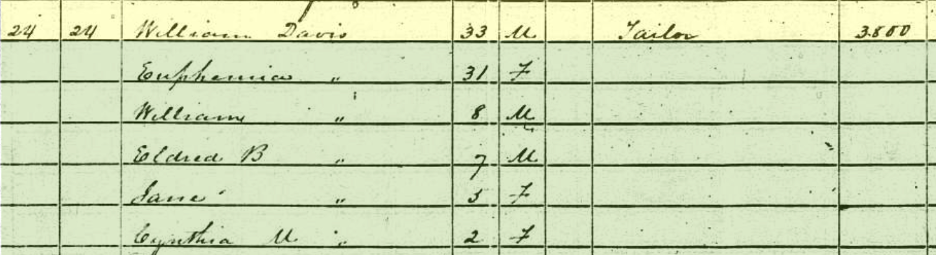
1850 census
By the time of the 1860 Census, William’s occupation was listed as “farmer.” The value of their real estate had grown to $6,000, with a personal estate valued at $3,260. (More on what THAT is likely all about in another post.)
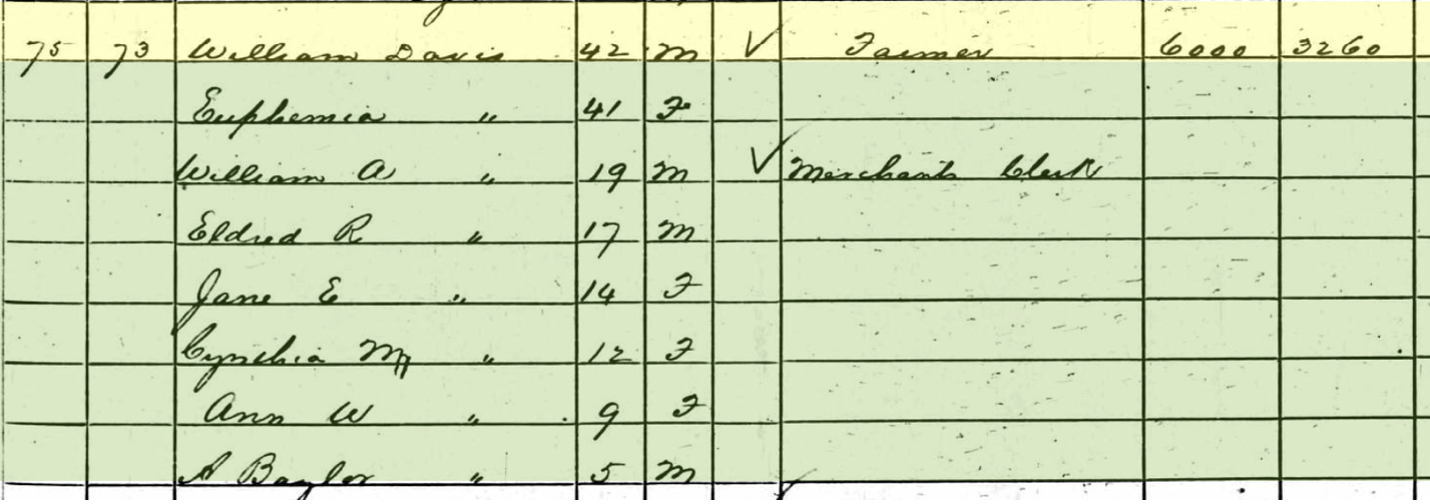
1860 census
William and Euphemia lived at 110 West Main Street in Christiansburg, VA, in a home they purchased in 1847 from George Clare, who built the house in 1826. A Kroger grocery store opened on the property in 1957.
Which brings me to my current brick wall.
Who were the parents of William A. Davis, Sr., and when did this family come to America? User-contributed content on Ancestry and FamilySearch suggests that the parents of William Davis were Henry Davis (1779-1842) and Sarah Stephens (1788-1855). However, I can’t find a document to prove it.
The reason this is important is that there is a well-documented trail from this likely father, (living in Wythe County, which was immediately adjacent to Montgomery County - Montgomery wasn’t created until 1777) to a James Davis (1708-1765).
William A. Davis, Sr. (1817-1900) – m. to Euphemia S. Baylor (1818-1910)
| -- THE MYSTERY LINK – is it correct?
Henry Davis (1779-1842) – m. to Sara Stephens (1788-1855)
|
Henry Davis (1730-1804) – m. to Jane Crockett (1740-1805)
|
James Davis (1708-1765) – m. Margaret Conn (1700-1749)
To increase the pressure on my meager genealogy skills, my wife has ALWAYS wanted to have Irish ancestors. And James Davis was pretty verifiably from Drumquin, Tyrone, Ireland.
Family Tree has these notes, which would be cool to directly link up to my wife’s William A. Davis, Sr. There is a LOT of Davis information in this document -- 204-238, Part I, Chapter IX HISTORICAL AND BIOGRAPHICAL INFORMATION ABOUT THE LIFE AND TIMES OF OUR THOMPSON AND W ARD ANCESTORS – more than I have been able to digest so far.
To obtain a legal right to hold property, importation had to be sworn to by the individual, or by others in their behalf, and we find James' importation from Ireland, to Pennsylvania, to Orange County, Virginia, sworn to for himself, Mary, William, Henry and Samuel, on July 24 1740 [Keglev's Virginia Frontier, pg. 425]. ...
On March 4, 1758, James gave to his sons - Henry, William, and Samuel, with love and affection - the 1,300 acres known as "Davis Fancy" on the Indian (Holston) River. To Henry went a portion of the South Fork known as the Beaver Dam. William and Samuel each received 350 acres. The deed was delivered to William Davis in May of 1765 [Chalkley III. pg. 351]. ...
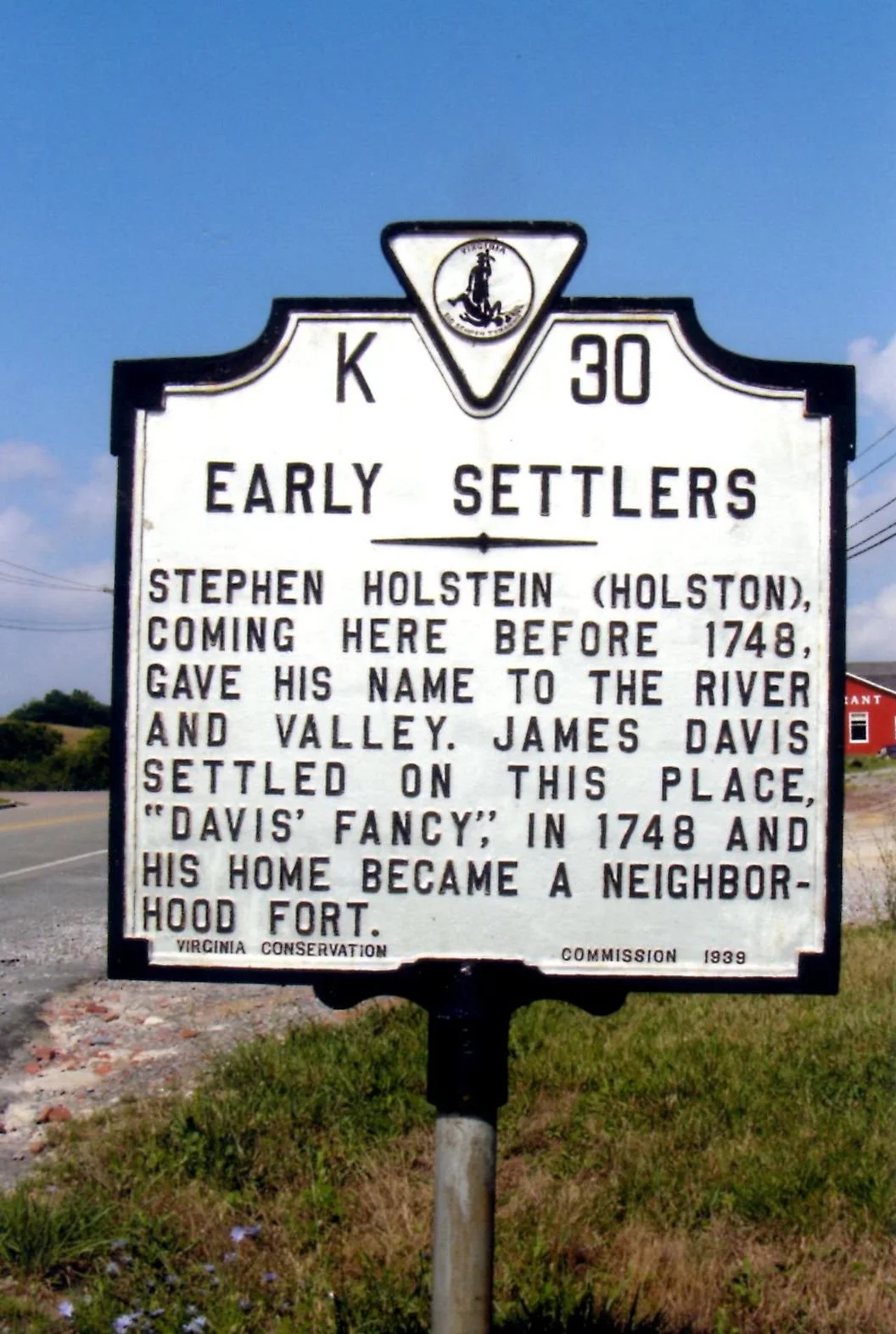
I guess my brick wall is more of a link that needs to be solidified.
Were Henry and Sara the parents of William A. Davis, Sr.?
Because from there, it’s a straight trail back from them to Ireland.
(Even though it's Northern Ireland, I won't tell my wife that.)
70ish: Lessons Learned is available in paper ($9.99) and Kindle ($2.99) on Amazon (https://www.amazon.com/70ish-Lessons-Learned-John-Mancini/dp/B0DV5GDMC9).
Immigrant Secrets too — https://www.amazon.com/Immigrant-Secrets-Search-My-Grandparents/dp/B0B45GTTPP.