Juneteenth -- A Reflection
Pictures can tell us a lot.
I spend a fair amount of time going through old pictures. My mom took a fair number -- at least of the first few kids (out of 6). There are many pictures of June and me as babies and a good chronology from that point forward. My sister Jeanne? One as a baby, another around First Communion, and then another graduating high school. But my mother-in-law was the champ. When we cleaned out my in-laws' home, we found envelope after envelope of pictures, often with backup duplicates. You can date the beginning of Kodak's decline to the date when she stopped taking pictures.
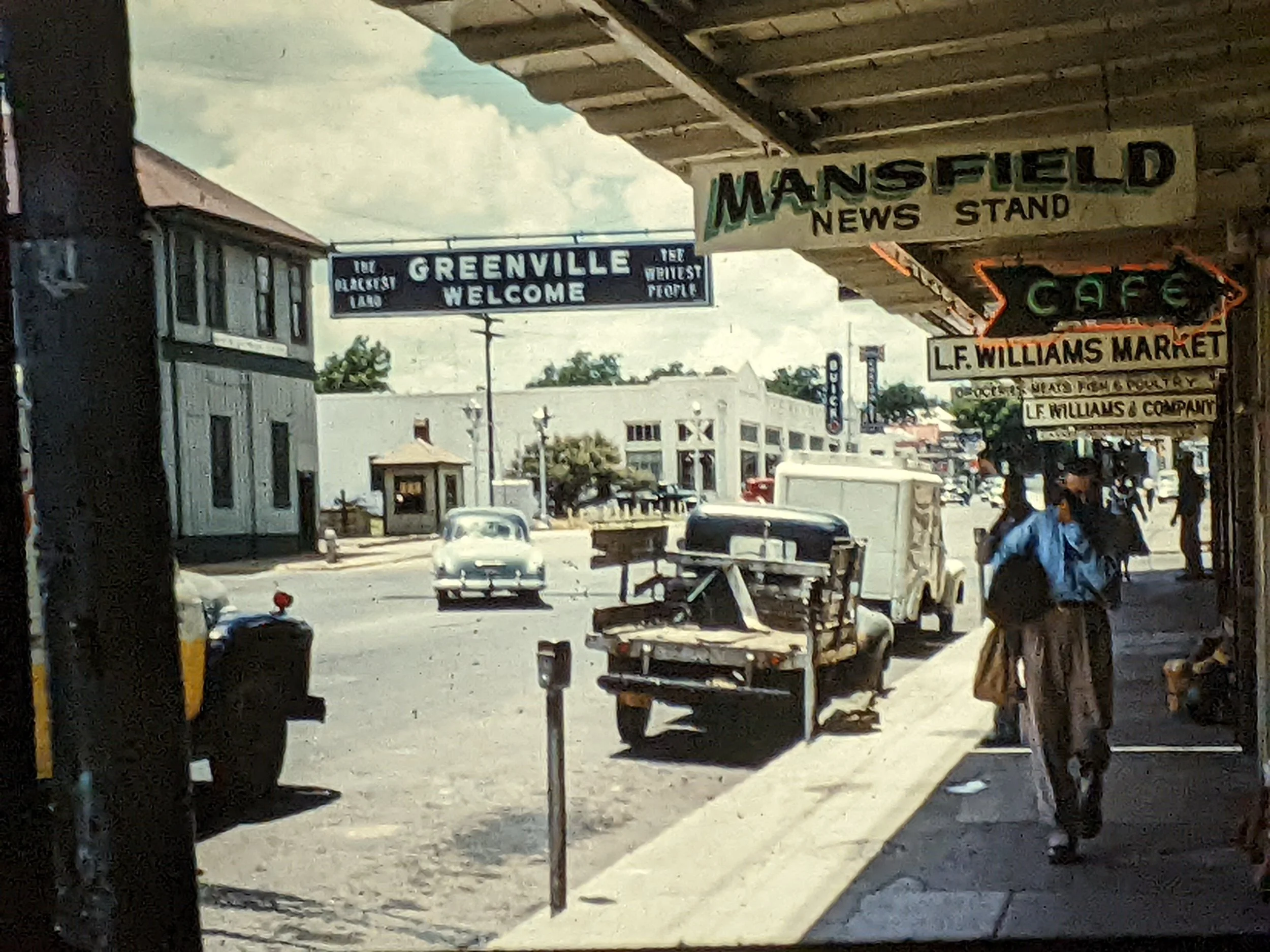
While rummaging through these treasure troves, a particular picture sometimes captures my attention, like this one.
I asked Claude.AI what it could tell me about this picture.
This appears to be a small American town named Greenville from what looks like the 1940s or 1950s, based on the style of the cars and overall aesthetic. The picture captures a typical small-town main street scene with its mix of commercial buildings, parked cars, and pedestrians going about their daily business. The realistic detail and lighting create a nostalgic view of mid-century American small-town life.
And then there’s the banner. The banner.
The banner reads "GREENVILLE WELCOME" with text indicating "THE BLACKEST LAND" and "THE WHITEST PEOPLE" - this appears to be Greenville, likely in the Mississippi Delta region, which was known for its rich, dark soil.
Well, yes, Claude.AI, the banner does indicate an area known for its "rich, dark soil." You may be missing the point. I push Claude a bit further: "What do you think the banner says about race relations in this town?"
The banner's message, "THE BLACKEST LAND, THE WHITEST PEOPLE," is deeply troubling and reflects the explicit racial segregation and white supremacist attitudes that were institutionalized in many Southern towns during the Jim Crow era.
This type of slogan was unfortunately not uncommon in the South during the mid-20th century. It appears to be simultaneously:
Promoting the area's agricultural wealth - the "blackest land" refers to the fertile, dark soil of the Mississippi Delta, which was prized for cotton farming
Making an explicit racial statement - the "whitest people" part was a deliberate assertion of white racial identity and exclusion
Such messaging was part of the broader system of racial apartheid that existed in the American South, where towns would sometimes openly advertise their racial demographics as a way to signal to both Black and white travelers what to expect. For Black Americans, it served as a warning about the hostility they might face. For white people, particularly those who supported segregation, it was meant as reassurance or even attraction.
This banner represents the intersection of economic boosterism with racial intimidation that characterized many Southern communities during segregation. It's a stark reminder of how normalized and public racial exclusion was in many American communities during this period.
The fact that this was displayed as an official town welcome sign shows how systemic and institutionalized these attitudes were at the time.
With a bit more research, I discovered the town in question is Greenville, Texas, located about 50 miles northeast of Dallas. The original sign was taken down and placed into storage on April 13, 1965, possibly at the urging of Texas Governor John Connally, who had made a visit to the town weeks before.
Even though the sign has been down for 60 years, I can't quite imagine the long tail of trauma it represents for African-Americans in Greenville. What does it mean to live in a place that so blatantly excludes you, right down to the banner when you enter the town? It's the kind of legacy that so many in the current Administration would like us to ignore -- "It was a long time ago. I didn't do this. Teaching our children that their grandparents might have been comfortable with this kind of sign might make our children feel uncomfortable. This is just WOKE nonsense. Can't we move on?"
Well, from my experience with our “lost” grandparents, it doesn’t work that way. Trauma has a long tail. Those guilty of doing the traumatizing do not get to set a timetable for when those who have been traumatized should be “over it.”
All of the above thoughts led me to explore life in Greenville, TX, further.
And it gets worse. A lot worse.
On July 28, 1908, a 17-year-old (Ted Smith, black) was accused of raping a 16-year-old (Viola de Lancey, white). She was purportedly returning from retrieving mail from a rural free delivery (RFD) box located about a quarter mile from her home. Word spread and a crowd formed and chased him across the countryside.
The local Courier-Gazette (July 28, 1908) described his arrest:
It appears that not very much is known of him, but he is sort of a musical character, as he was quietly picking a banjo when the officers went to the house where he was captured. When asked if his name was Smith, he replied that it was, but he had nothing wrong. That led the officers on to the game, and they told him it did not matter whether he had done anything wrong or not; they wanted him.
Under the promise of "safe passage" back to the jail, Smith was taken to de Lancey's home, where she identified him. On the way back to jail, Smith was seized by the crowd.
The mob overpowered the officers finally and took the negro to the north side of the square, where a rope was procured. But other heads prevailed for a more impressive death, so it was decided to burn him. To that end, a cord of wood, some kindling, and oil were procured, and the negro was placed on top of it all, and the torch applied. The negro would not admit that he committed the deed -- shouted his innocence from the time he was captured on the Norman place as long as he could talk. The burning took place on the south side of the public square, right in the heart of the business part of the town, and there were fully 2,500 people there to see it. After the mob got the negro there was no demonstration to speak of, as it was all done in as orderly a fashion as could be thought of, though the mob had to drag him to the place of burning. (Courier- Gazette, July 28, 1908)
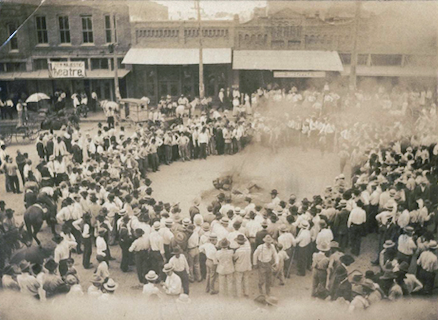
Source: Lynching in Texas Staff, “Lynching of Ted Smith,” Lynching In Texas, accessed June 18, 2025, https://www.lynchingintexas.org/items/show/548.
Perhaps as appalling as the deed itself was the coverage it received around the country, coverage that clearly bought into the narrative that a) this was justified and b) the perpetrator was something less than human. According to numerous reports, "During the burning, an old negro made a remark about it being too bad, and he was severely horsewhipped." I could not find a single article in any paper -- northern or southern -- that questioned the murder of Ted Smith

No one was ever prosecuted. The "business" of intimidating and threatening African-Americans in Greenville returned to normal. I'm sure the banner over Main Street likely seemed humorous to many whites. Not so much to African Americans.
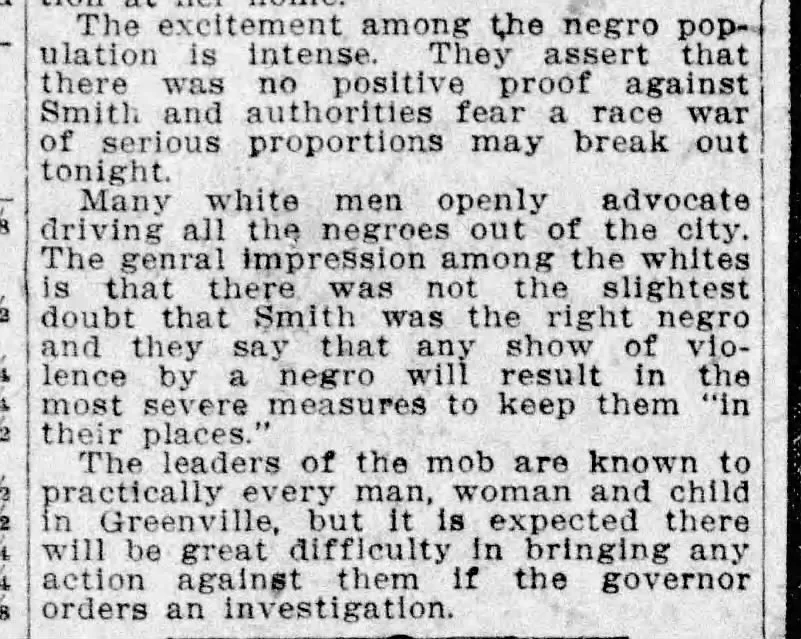
Oregon Daily Journal
It would be 115 years -- 2023 -- before the crime was formally acknowledged -- ‘Never Again’: Community Reflects on Lynching 115 Years Later.
The ceremony was held in the 196th Judicial Court Room in the Hunt County Court House and was hosted by the Corporation for Cultural Diversity, in partnership with the Equal Justice Initiative (EJI), NAACP Greenville Chapter and the Greenville Interdenominational Ministerial Alliance.
Two proclamations were read, and Smith’s family members were presented with a plaque from the EJI Project that reads: “Mr. Ted Smith, an Afro-American, was denied legal rights and ‘due process’ by the local justice system. He experienced an untimely and unjustified death in 1908 by a local riotous mob. We stand for Justice, NEVER AGAIN!”
The EJI runs the Soil Collection Project, which gathers soil from lynching sites and places it in jars bearing the victims’ names. Smith’s jar will join the 800 other jars on display at EJI’s headquarters in Montgomery, Ala. One of Smith’s jars will remain in Greenville, along with the jars of Thomas Peddy and George Lindley, who were previously honored.
And here we are in 2025. Tomorrow is a federal holiday -- Juneteenth -- a holiday that is barely on the radar of most white people. Juneteenth celebrates the end of slavery in the United States, specifically commemorating June 19, 1865, when enslaved people in Texas finally learned they were free. The holiday marks the day in 1865 when Union troops reached Galveston Bay, Texas, and declared the state's last enslaved people to be free under the Emancipation Proclamation.
Under Trump's second Administration, celebrations across the country are being scaled back or canceled as organizers cite safety problems and mounting resistance to diversity, equity, and inclusion initiatives. Federal agencies have banned celebrations related to MLK Jr. Day, Women's History Month, Juneteenth, and other "special observances" to comply with Trump's executive orders. Federal agencies bar Black History Month and other 'special observances' targeting DEI programs.
Wishing away trauma and seeking to sweep it under the rug may work for the perpetrators and the complicit.
But it never works for the victims.
Trauma has a long tail.
70ish: Lessons Learned is available in paper ($9.99) and Kindle ($2.99) on Amazon (https://www.amazon.com/70ish-Lessons-Learned-John-Mancini/dp/B0DV5GDMC9).
Immigrant Secrets too — https://www.amazon.com/Immigrant-Secrets-Search-My-Grandparents/dp/B0B45GTTPP.