Immigrant Secrets - Chapter 1
This is the second of a series of Excerpts from Immigrant Secrets, the story of how I solved the mystery of my lost grandparents. I am struck that today is 38 years since the passing of my dad, and 38 years and one day since the birth of our second son. A lot of remembrances.
It would make a great holiday gift for someone who is interested in history or genealogy or really anyone who just likes a good mystery. I hope you’ll give the book a look.
Purchase link - https://www.amazon.com/Immigrant-Secrets-Search-My-Grandparents/dp/B0B45GTTPP.
——-
O N E
It was late at night in 1987 when the phone rang. I was not expecting a call and had a bad feeling when I answered it. “I’m afraid I have bad news,” my mother said when I picked up the receiver. “Your father went into the city as usual this morning, and then just didn’t come home. It took a while to track him down. I called some of his coworkers and then the state police, but they knew nothing. You know how he’s usually reliable as clockwork. I finally called the local police, and they eventually tracked him down.”
My head nodded methodically as a sense of dread rose by the second.
“He apparently had a heart attack on the way to his first ap-pointment, and he got separated from his wallet, which is why it took so long to track him down. He’s alive, but in a coma at Bellevue Hospital in Manhattan.”
“OK. I’ll be there tomorrow.” That’s how I found myself on the Amtrak, headed up to New York a week after the due date for my wife and our second child, but before child number two decided to make his formal appearance. I planned to go up and back on the same day, one foot headed to New York to be with my father in a coma, and the other foot still firmly rooted in Herndon and waiting for labor to begin.
Bellevue was . . . well it was chaotic for a suburban kid. In a bit of fog, I stared at the mission statement on the mes-sage board at the main entrance:
“Bellevue is America’s oldest operating hospital, established in 1736 . . . Our mission is to provide the highest quality of care to New York’s population and to deliver health care to every patient with dignity, cultural sensitivity and compassion, regardless of ability to pay.”
All the way up on the train, the name Bellevue kept pick-ing at my consciousness. Why was this name so familiar? I had never been there, and yet some sort of familiarity kept pushing through. As I stared at the inspiring mission statement—and thought about the fact that this place had been there for 250 years—it came to me. Bellevue. Growing up in the shadow of New York I couldn’t believe it had taken me the entire train ride—plus the chaos in the lobby—to remember: Bellevue was where the crazy people were.
Though Bellevue is now a full-service hospital, it was once pop-ularly associated with the treatment of mentally ill patients who required psychiatric commitment. The name “Bellevue” was short-hand in the New York area—even across the country—for lunatic asylum. As David Oshinsky wrote in Bellevue: Three Centuries of Medicine and Mayhem at America’s Most Storied Hospital,
You can’t factor out Bellevue as a psychiatric hospi-tal. When I was growing up as a kid in New York City, when I was acting weird my mother would say, “Keep it up and you’re going to Bellevue.” It was like a national punch line.
This was the place where author Norman Mailer was taken after he stabbed his wife. This was the place where Mark David Chapman was brought after he shot John Lennon. This was the place mentioned by name by Allen Ginsberg in his poem “Howl,” and where he was a patient. High school English came in handy for something after all.
Of course, this is not the way we talk about mental illness today, and I am not making light of mental illness. But I can hear my parents now, “Keep it up kids, and we’ll all wind up in Bellevue.”
Be careful what you wish for. It looked like were all there now. By the time I arrived from DC, things had gone downhill with my father. He was still in a coma. The doctors told my mother, “Things don’t look good; there doesn’t seem to be evi-dence of brain activity.” My father would have had a field day with that after all the jokes he had made over the years about leaving his brain at the office.
He looked peaceful. Frankly, he looked good. He looked like he was planning the most incredible practical joke ever. “I told you we would all wind up in Bellevue!”
My sister Jeanne quickly took a flight back from college. “The man sitting next to me on the plane was a businessman,” she told me. “He had a suit and tie on. And he asked me why I was going to New Jersey, and I told him and then I started sobbing and sobbing. And he was the nicest man and he kept saying that things would be alright and hugged me when I got off the plane.”
But I knew just looking at my dad that this was not go-ing to end well. I don’t remember this, but my sister Jennifer says that someone was handcuffed in the bed next to my father in the ICU, and there was a guard. My brother Joseph remembers that a patient periodically wandered into the wait-ing room looking in the ashtrays (yes, you could smoke in a hospital waiting room at the time) for unfinished cigarette butts. To add to the charm, the pants on the cigarette seeker were only loosely gathered around his waist and kept falling down. Not good signs.
So many things ran through my head. Just two months earlier—our last out-of-town trip before the “no more trips” part of pregnancy—we had been home to New Jersey. We had all been standing on the back deck, and my father was bounc-ing up and down, up and down, on a portable trampoline. My mother’s words echoed in my mind, “Joe, be careful. You’ll have a heart attack.” Sigh.
While I went through the motions of pleading with God for a miracle, to grant this funny and quirky man a sudden, last-minute reprieve from a Divine Healer, in my heart of hearts I knew it was not to be. I thanked him for being a great father. I uttered a few curses that it had to come to this, at age 62. I hoped he heard me. I kept waiting for some unexpected twitch or eye-blink to signify that he knew I was there, but it was not to be.
As I left the room, and looked back at him just lying there under a sheet, I knew I would not see him again. That he would never meet his new grandchild. That I would never get to ask him all the things I should have asked him, but never did, as-suming time would extend out forever. Or at least for a while longer. Except that it didn’t.
After a few hours, I left Bellevue, hoping to never hear of this place again, and went back to DC.
A few days later, our son William was born. The day after that, my father died. Even though all the machines were showing flat-lined brain activity, my sister Jennifer says that after my mom told him about William, a tear rolled down his face.
On the death certificate, under parents, it lists Frank and Elizabeth Mancini.
So many questions.
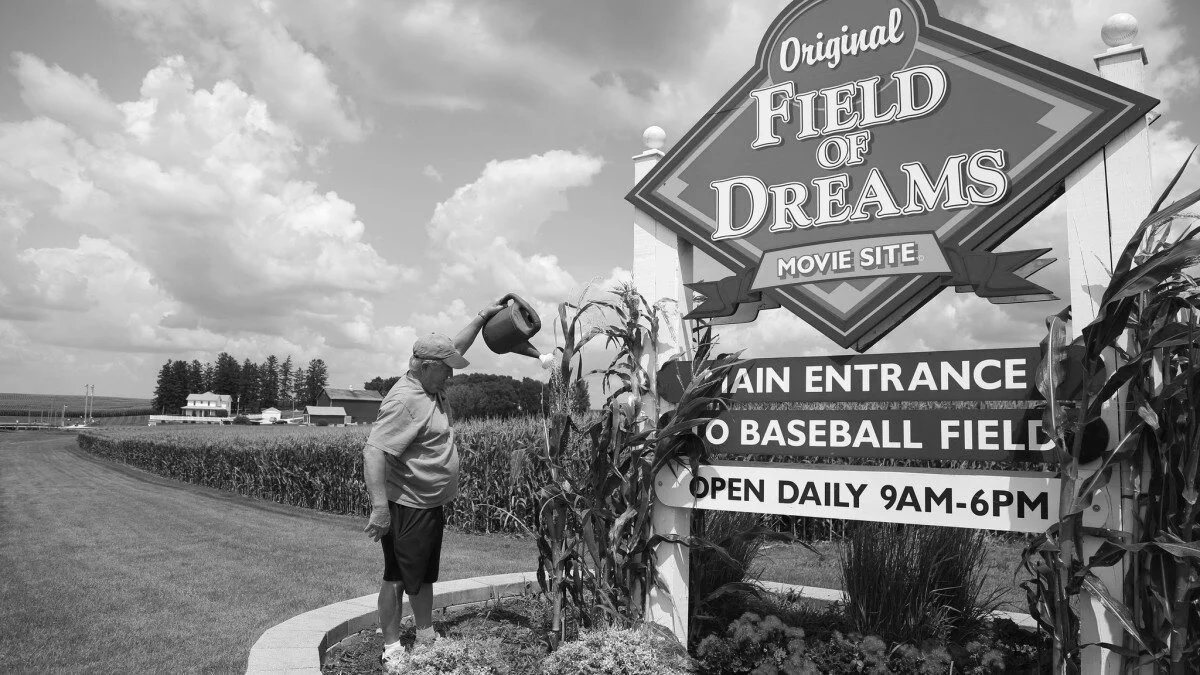
Normally, my business trips were functional. Fly in somewhere. Go to a hotel. Give a speech. Fly home. But for my trip to Iowa in 2000, once I found out that the Field of Dreams was only sixty-one miles away—the iconic baseball field built next to an Iowa corn field in the movie by the same name, in which Ray Kinsella is urged by a mysterious voice to build a baseball field in part of his cornfield in the hopes of fulfilling a dream—I knew I must go. Even if it meant an extra overnight stop.
All the way up, driving through endless fields of corn, I marveled at how amazingly dark it is out in the middle of the country. It was “inside your pocket” dark. I started to worry a bit about the stories that might arise if I should slam into some cow suddenly crossing in front of me in the middle of all this darkness at sixty miles per hour. I can’t remember if I told any-one I was indulging in this diversion, and now I found myself on this lonely stretch of highway, driving away from the place where I was scheduled to give my speech.
Fortunately, I encountered no cows and pulled into the park-ing lot at the Colonial Inn. Probably unnecessarily, I had made a reservation, and someone was waiting up for me to give me the key. The room was only $29 per night, with wire hangers in the “closet” area included at no extra charge.
I woke up the next morning still a bit surprised that I had made this trip. It was quite foggy, and I decided to wait out the fog. Truth be told, I was not quite sure what I would find when I got to my destination, which is why I was dragging my feet. A core Mancini family value is a fear of looking foolish, and it dawned on me that when I tell people where I have gone, they will think I am nuts.
After I had stopped at a diner and had eaten at least 1000 calories, I decided that I could not procrastinate any longer. According to my printed directions—this was a pre-MapQuest, pre-GPS era—my quest was just four miles away. In the movie, the character Terrence Mann (played by James Earl Jones) is a frustrated and alienated writer looking to find the idealism that vanished in the wave of success that followed his early books. His voice came to me during my hesitation:
People will come, Ray. They’ll come to Iowa for reasons they can’t even fathom. They’ll turn up your driveway not knowing for sure why they’re doing it. They’ll arrive at your door as innocent as children, longing for the past (Robinson, Phil, dir. 1989. Field of Dreams. Los Angeles: Universal Pictures).
And suddenly I arrived. At the Field of Dreams. Truth be told, I was not quite sure why this visit was important to me.
I was the only one there. There was no admission fee, no gate. Just a curious trailer-esque souvenir stand that was not quite open yet. Other than that, it was just like walking directly into the movie. I was surprised at how faithful this place was to the peacefulness of the movie, that it had not been turned into some marketing machine. At least not yet. I guessed it would not survive in this condition forever.
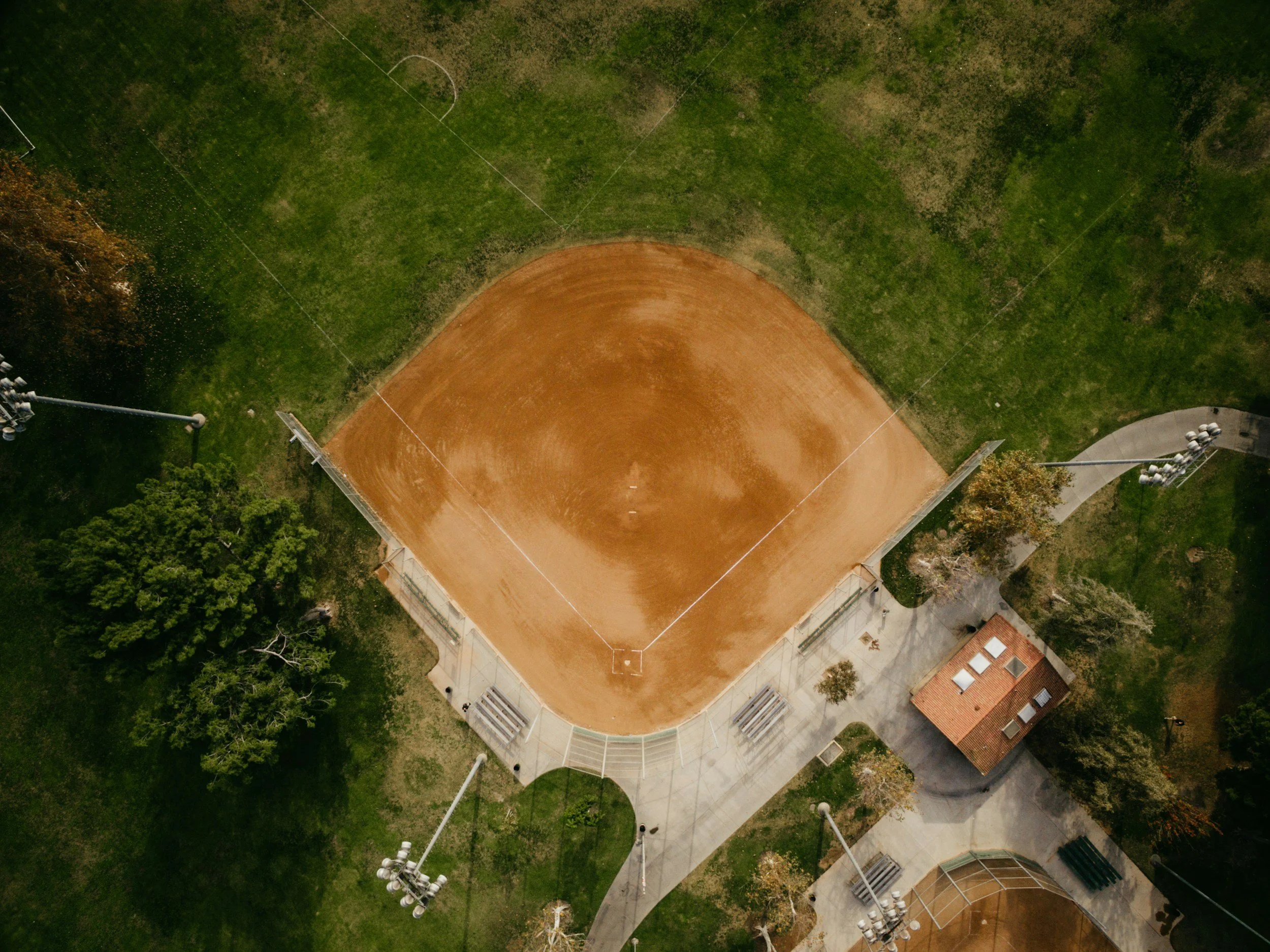
It was, well, just a baseball field. A small backstop, a field, and lights. The outfield was bordered by corn, a living home run barrier around the perimeter of the outfield. Aside the field between home plate and first base were the small bleachers that are the setting for much of the action in the movie. A couple of hundred yards behind the bleachers sat the beautiful white country house with its wraparound porch and the famous porch swing where you could sit in the twilight hours when the fireflies came out, for those moments when it seemed that all was well with the world. I stared out at the edge of the corn-field, a place where the lines seemed to blur between what was real and what could be.
Moonlight Graham was a minor league ball player who got the opportunity to play one game in the major leagues. He was played by Burt Lancaster in the movie. I recalled Lancaster’s most famous line in the movie:
We just don’t recognize life’s most significant moments while they’re happening. Back then I thought, “Well, there’ll be other days.” I didn’t re-alize that that was the only day (Robinson 1989).
After coming on this strange side trip, I realized I was hoping that this might not be just one of those “other” days. Not just another of those mindless fly-sleep-eat-speak-fly business trips. Perhaps it could be one of those days. As the James Earl Jones character (Terrance Mann) wrote, “There comes a time when all the cosmic tumblers have clicked into place and the universe opens itself up for a few seconds to show you what is possible.”
Yeah, perhaps I was expecting a bit much from a visit to a small town in eastern Iowa.
Just as my latent cynicism was about to rear its head, I no-ticed a guest book, and started to leaf through the pages.
My father and I are meeting here today after not speaking to each other for 15 years. Wish me luck. I hadn’t even seen the movie when my kids arranged this trip and told me to bring a baseball glove. I thought they were nuts. They were not.
I hope that something magical happens when I go out into the corn. I could really use it right now.
We brought our gloves and just stood in the infield throwing the ball around. I had seen the movie, the kids had not. They couldn’t understand why I was crying.
Starting chemo tomorrow. I just sat on those little bleachers for an hour. It felt like I was glued to the spot. I just stared at the field, and the bus load of tourists from Minneapolis just faded into the back-ground. For a few moments, I was 12 years old and back at the Polo Grounds.
Page after page after page of people pouring out their hearts. What a strange place.
During the movie, the mysterious players who come every day to play on Ray Kinsella’s field miraculously appear and dis-appear from the corn that borders right field. The players just slowly emerge from the corn when it’s time to play, and slowly disappear when the day is done. The edge of the corn field is the tipping point at which the cosmic tumblers click into place.
Terrance Mann is determined to find out what happens in that cornfield.
Ray. Ray. Listen to me, Ray. Listen to me. There is something out there, Ray, and if I have the courage to go through with this, what a story it’ll make (Robinson 1989).
In a moment of pure irrationality, I decided what the hell; I was going to walk out to the cornfield and see if anything happened. Like the characters in the movie, I slowly eased up to the right field corn wall and poked my head in tentatively. I looked back to see if anyone else had arrived and was witness to my foolishness. No one was here. OK.
I stepped into the corn. Nothing. I stepped in a few steps more. I came back out of the corn into right field and tried again. In. Out. In. Out. Maybe there was a trick to this. Nothing.
Truth be told, I never fully expected that I could enter the movie and that my father would actually appear and offer to have a catch with me, although I think I had hoped for at least a glimpse into what lay beyond the corn. A glimpse of what his life had meant, of what he had hoped his life would be, and whether he was at peace.
But alas, while I still retained some of the warm fuzzies from the guest book, this was not to be a day for cosmic tum-blers. I headed back to the parking lot, and stopped for a souve-nir mug at the trailer, a mug featuring the characters from the movie standing amidst the corn. The package said that when you added hot liquid to the cup, the characters disappeared into the corn. That’s at least something, I guess.
I hopped into the rental car and headed back the sixty miles to Cedar Rapids for my speech. Thoughts of my father surrounded me in a cloud. Perhaps the field had worked some sort of magic after all, just not exactly what I expected.
“Ease his pain.”
——-
This is the second of a series of Excerpts from Immigrant Secrets, the story of how I solved the mystery of my lost grandparents.
It would make a great holiday gift for someone who is interested in history or genealogy or really anyone who just likes a good mystery. I hope you’ll give the book a look.
Purchase link - https://www.amazon.com/Immigrant-Secrets-Search-My-Grandparents/dp/B0B45GTTPP.