Immigrant Secrets - Chapter 3a
This is the FOURTH of a series of Excerpts from Immigrant Secrets, the story of how I solved the mystery of my lost grandparents, Francesco and Elisabetta.
It would make a great holiday gift for someone who is interested in history or genealogy or really anyone who just likes a good mystery. I hope you’ll give the book a look.
Purchase link - https://www.amazon.com/Immigrant-Secrets-Search-My-Grandparents/dp/B0B45GTTPP.
——-
Dio volendo lo faro. (If God wills, I shall do this.)
FRANCESCO AND ELISABETTA, 1904
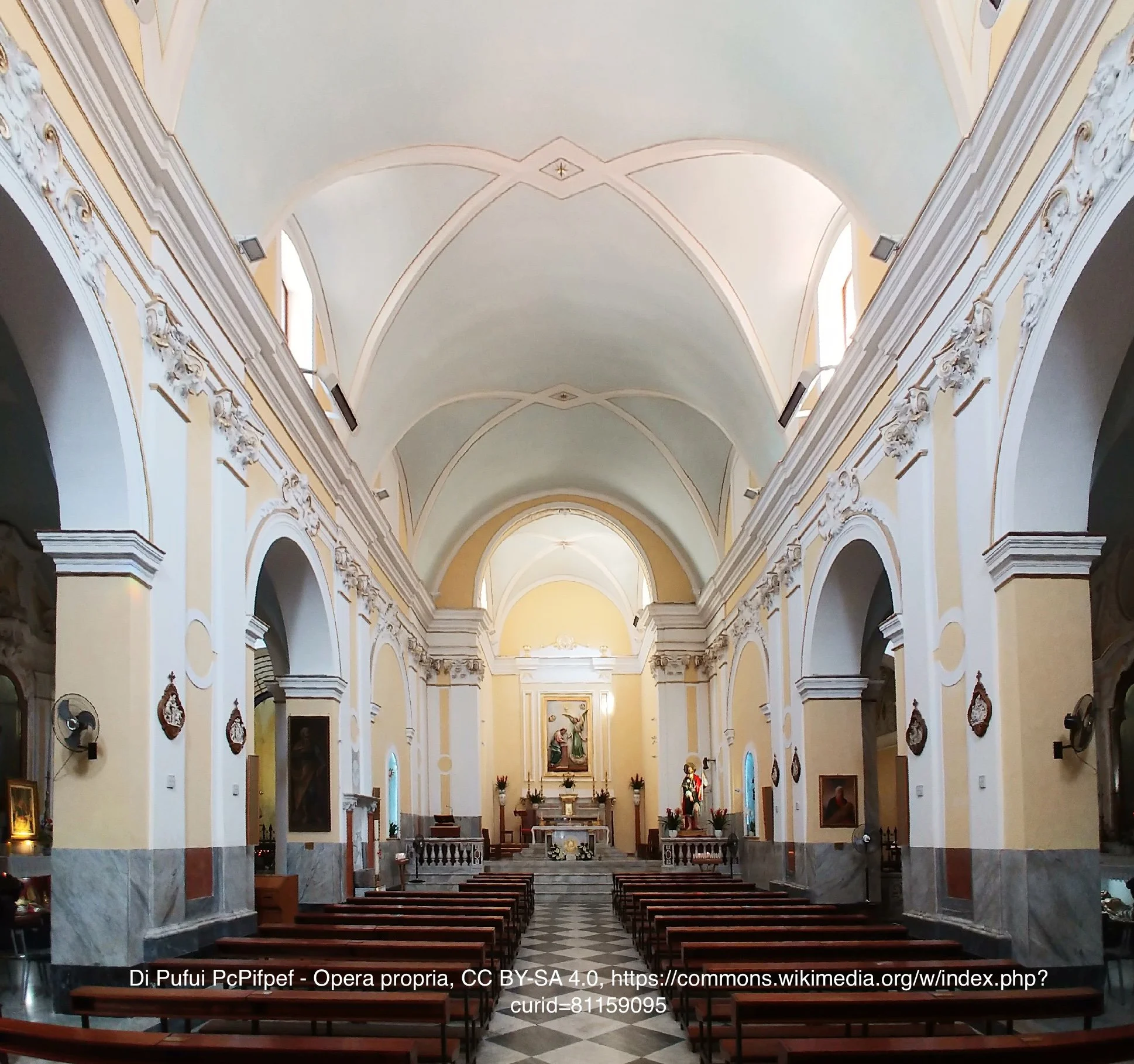
The entire family—all except Michele, who had gone to America the previous year—went to the Piazza. Everyone was so excited, and Elisabetta tried so hard to stay awake for whatever was to come. But to no avail.
Elisabetta fell asleep in Teresa’s arms. She loved Teresa so much, Teresa who was almost a second mother to her. Teresa, who would comfort her when all others failed. Teresa, who would slowly rock her to sleep most nights.
Just as she had fallen off to sleep, there were voices. Loud and insistent screams and yells woke her from her deep sleep. And all around her, fires. Everywhere. All over town. She began to cry.
Teresa brought Elisabetta’s face close to hers to calm her and so Elisabetta could hear her above the shouting. “Tiny one, no need to be afraid,” Teresa said. “It is just the bonfires of the Festa di San Giuseppe, lit to celebrate Saint Joseph.” As Elisabetta watched, hundreds of tiny embers rose into the sky, creating beautiful—but temporary—constellations of light. “Look closely into the stars created by the sparks. It is said you can see the future.”
She put Elisabetta down next to her and held her hand tightly. “And now, everyone will dance and sing to celebrate all fathers, starting with Giuseppe, the father of our Lord.” Teresa crossed herself. “All day, my tiny one, we have been preparing the zeppole di San Giuseppe. I can taste them now. Just wait a few minutes more.”
Teresa turned Elisabetta to face her and shifted Elisabetta’s feet so they rested upon her own. They twirled and danced around the fire. Elisabetta watched the lights dancing off Teresa’s face, round and round as if it would never stop.
Then Elisabetta saw it. Hardly discernible to anyone but her, a shadow passed over Teresa’s face, and for the first time a fear of loss swept over Elisabetta, although at two and half, she had no name for this. She shivered.
Teresa sensed the change immediately and swept Elisabetta into her arms and held her close. She rocked her back and forth, slowly singing her the lullaby that Mama had sung to her many years ago.
Ninna nanna, ninna oh Questo bimbo a chi lo do? Se lo do alla befana
Se lo tiene una settimana Se lo do al lupo nero
Se lo tiene un anno intero Se lo do a lupo bianco
Se lo tiene tanto tanto
Ninna oh ninna oh A nessuno lo daro.
Lullaby, lullaby, lullaby, ooh Who will I give this baby to?
If I give her to the kind witch For a week she will keep her If I give her to the black wolf
For a whole year he’ll keep her
If I give him to the white wolf For very long he’ll keep her Lullaby, lullaby, lullaby, hmm
To no one I’ll give you, my treasure.
As Teresa continued to sing the lullaby over and over, Elisabetta did indeed finally fall asleep. But in between iter-ations of the lullaby, she heard Teresa quietly weep, “Oh my treasure, I wish that were a promise I could keep. How will you ever understand? I need to leave you next month. This is not my choice. Papa has decided that I am to go to America.”
1911
Elisabetta stood in the center of Piazza Incoronazione, in the same spot where each year she basked in the warmth of the many bonfires to celebrate the end of winter and the Festa di San Giuseppe. All around the small piazza Elisabetta saw a series of three-story apartment buildings, each with shut-tered windows, a kaleidoscope of blue, aqua, and orange. The apartments on the second and third floors were surrounded by iron railings and window boxes filled with pretty flowers.
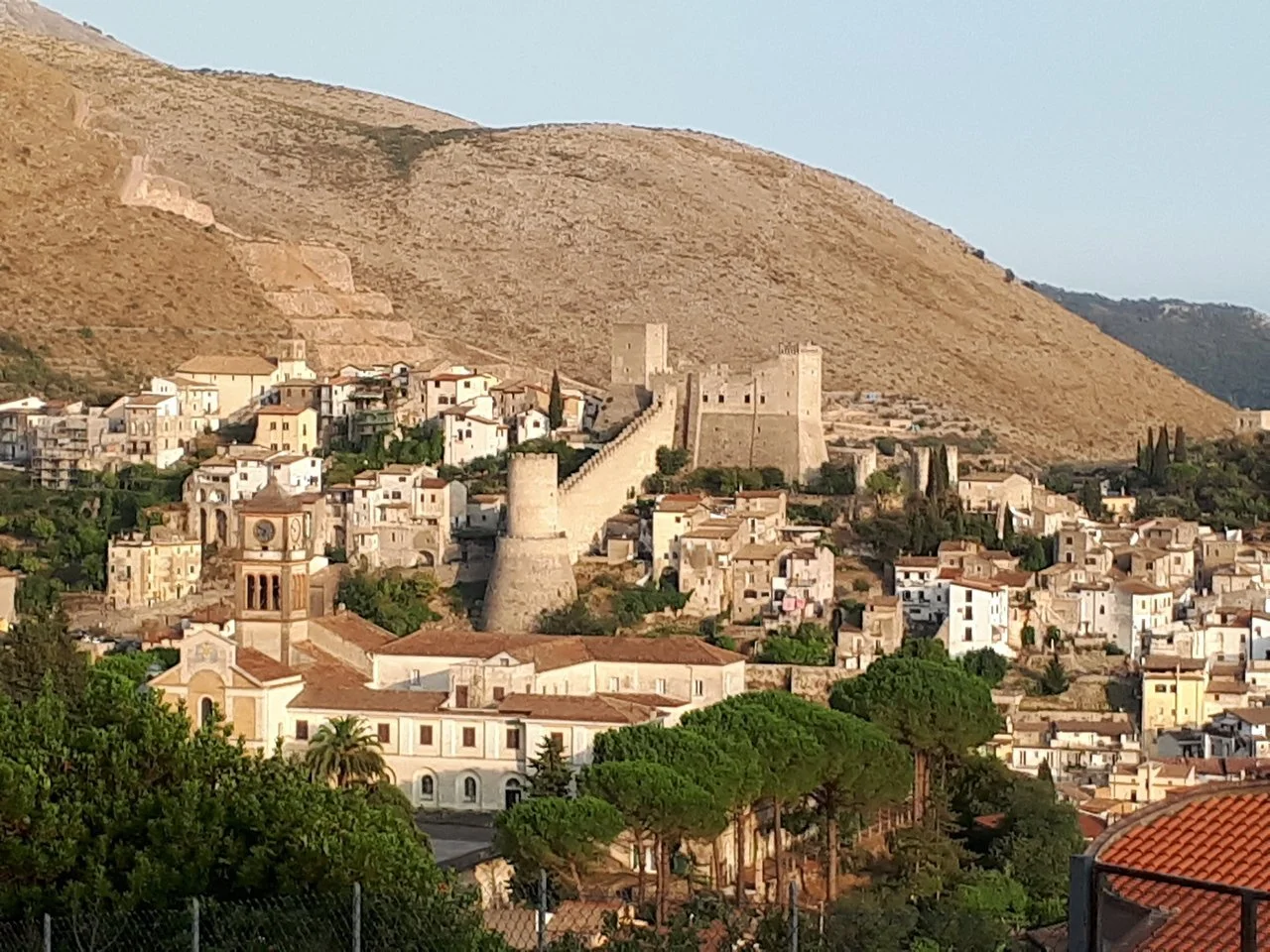
Above the tops of the apartment buildings, she saw the tops of hills surrounding the valley. And looking between the buildings, she saw the steep slopes leading to hills and beyond the hills to the mountains.
On the hills were row upon row of olive trees. The Itrana olives were the pride of this region, bright green in color and speckled with pink, harvested early each year during La Sagra dell’Ulivo— the Olive Festival. The olives produced a fresh and vibrant green olive oil.
Where there were no olive trees, there were fields of bril-liant yellow ginestra, a noble flower that suffered from the name “broom” because they were sometimes made into brooms. Across the hills, she could also see thousands of wildflowers, appearing each spring as if by magic, and followed shortly af-terwards in June by swarms of fireflies. The alternating fields of ginestra, olives, and wildflowers created beautiful patterns of color across the landscape.
Turning again, she saw a familiar castle, a round tower—the Alligator Tower—with jagged teeth at the top. In medieval times jailers threw the accused off the top and into the moat at the bottom. Leading up to the Alligator Tower was a steep connecting wall with many steps leading up to a rectangular tower, the highest point in the town. From there you could see the four towers out in the countryside that had stood watch over Itri for more than five hundred years, guarding Itri from marauders arriving by ships from the Tyrrhenian Sea or arriv-ing by land through the Via Appia Antica, the ancient Appian Way, running straight through the center of Itri.
Ruins of Roman times were scattered all around town and along the Via Appia Antica. Elisabetta loved to walk along the ancient road, past lines of drying laundry connecting walls that were more than two thousand years old. She would pause in front of the old doorways, lost in thought, imagining the comings and goings through them over the centuries. She loved the ragged stone arches magically held in place by a single capstone. Thousands of pounds of stone held in place by a solitary stone.
Rectangular paving stones were pockmarked by centuries of wear, and laid out in a mosaic of black, gray, and an occa-sional orange. The stones were all so remarkably symmetrical, seemingly laid in a predetermined pattern and yet simultane-ously also somehow unplanned, ordered yet not preordained. At times she thought she could hear dim voices from the stones in the street, sharing their long-forgotten secrets.
On a hot day in July 1911, there were more than dim voic-es coming from the stones. There were angry voices. The voices rose as more and more townspeople came into the Piazza from one end, and Sardinians—hired to work on the construction of the fifth trunk line of the Rome-Naples railway—poured into the Piazza from the other.
Sweat and arms had been needed for the railroad. A thou-sand Sardinian workers were recruited, and about five hundred more were working at a construction site a few miles from town. There were men coming from all over Sardinia. Many had fled Sardinia, eager to avoid the hell of working in the Sulcis mines and desperate for a new life.
Mr. Vincenzo, an ufficiale anziano (railway official) at the railroad, was in the middle of it all, towering above everyone on horseback. Something about Mr. Vincenzo had always made Elisabetta uneasy, even though he was quite an important man in town. He wasn’t a bad looking man, but not quite handsome either. But it wasn’t his looks; it was his manner. What exactly is it? wondered Elisabetta. And then it came to her. He always acted as if everyone was a potential threat. He trusted no one. As a result, no one trusted him. Whatever the problem was, he always seemed to make it worse.
As the crowds gathered in the Piazza, and as the Sardinians gathered around his horse and quickly surrounded him, the tension rose. Elisabetta felt shadows—she counted perhaps nine or ten—growing around the Sardinians in the Piazza. They were not shadows of fear or shadows of simple forebod-ing—she was well acquainted with these—but something far more profound. She shivered as she realized they were shadows of death, and ducked behind a column in front of the church. Mr. Vincenzo said something—she couldn’t quite tell what—that inflamed the Sardinians, and they began screaming curses at him. As tensions rose among the Sardinians, they also rose among her neighbors and her friends in the square—who screamed curses back at them.
Elisabetta breathed a sigh of relief as the carabiniere (po-lice) arrived, seemingly out of nowhere, adding even more horse-mounted men and tension to the Piazza. She was aston-ished when they quickly arrested a Sardinian, a man named Giovanni Cuccuru of Silanus. The yelling and curses grew louder and more fevered until the carabiniere threatened to kill Cuccuru if the protests did not cease and if the Sardinians did not leave the Piazza immediately. The shadows all around the Piazza grew more tense and ominous for Elisabetta until something seemed to break all at once, and the Sardinians left the Piazza.
Over the next few hours, the crowd of townspeople in the Piazza grew. Many of the newcomers brought pitchforks and daggers and guns and sticks. The mayor arrived and council-ors and additional carabinieri. Elisabetta wanted to leave, and knew she should leave, but somehow couldn’t.
The noise in the Piazza subsided for a few moments, and Elisabetta noticed that Mr. Vincenzo was once again on his horse and beginning to speak. “Our honor has been challenged! Have we not put up with these foreigners in our midst for long enough?” he yelled over the crowd. “They don’t understand our ways! They are taking jobs from Itri men. They don’t dress like us or act like us. They are dirty and criminals. They are sar-dignoli (donkeys).”
A huge cheer went up. “We must find these dirty Sardinians and bring them to justice!” someone yelled. The crowd began chanting, “Uccidili! Uccidili! Uccidili! (Kill them. Kill them. Kill them.)”
In the middle of them all was Francesco. He was four years older than Elisabetta was, and she idolized him. Her papa and Mr. Mancini had even begun to discuss him as a possible hus-band. Francesco looked so much older than his fourteen years as he screamed with the other men, but he also looked like he was just a boy.
Suddenly they all rode off, gone in gangs in pursuit of the Sardinians, who had fled to the countryside and were in hid-ing. By the time everything was over, ten Sardinians were dead. Sixty were injured. Many Sardinians who escaped the massacre were arrested on charges of being “quarrelsome.” Others were sent back to Sardinia.
Elisabetta—while no fan of the Sardinians herself—had seen a side of Francesco that worried her. A chill went down her spine as she recalled that when Francesco had joined the men in screaming at the Sardinians, shadows of pain—shadows that only she could see—surrounded Francesco as well.
——-
This is the FOURTH of a series of Excerpts from Immigrant Secrets, the story of how I solved the mystery of my lost grandparents, Francesco and Elisabetta.
It would make a great holiday gift for someone who is interested in history or genealogy or really anyone who just likes a good mystery. I hope you’ll give the book a look.
Purchase link - https://www.amazon.com/Immigrant-Secrets-Search-My-Grandparents/dp/B0B45GTTPP.