Immigrant Secrets - Chapter 3b
This is the FIFTH of a series of Excerpts from Immigrant Secrets, the story of how I solved the mystery of my lost grandparents, Francesco and Elisabetta.
It would make a great holiday gift for someone who is interested in history or genealogy or really anyone who just likes a good mystery. I hope you’ll give the book a look.
Purchase link - https://www.amazon.com/Immigrant-Secrets-Search-My-Grandparents/dp/B0B45GTTPP.
1913
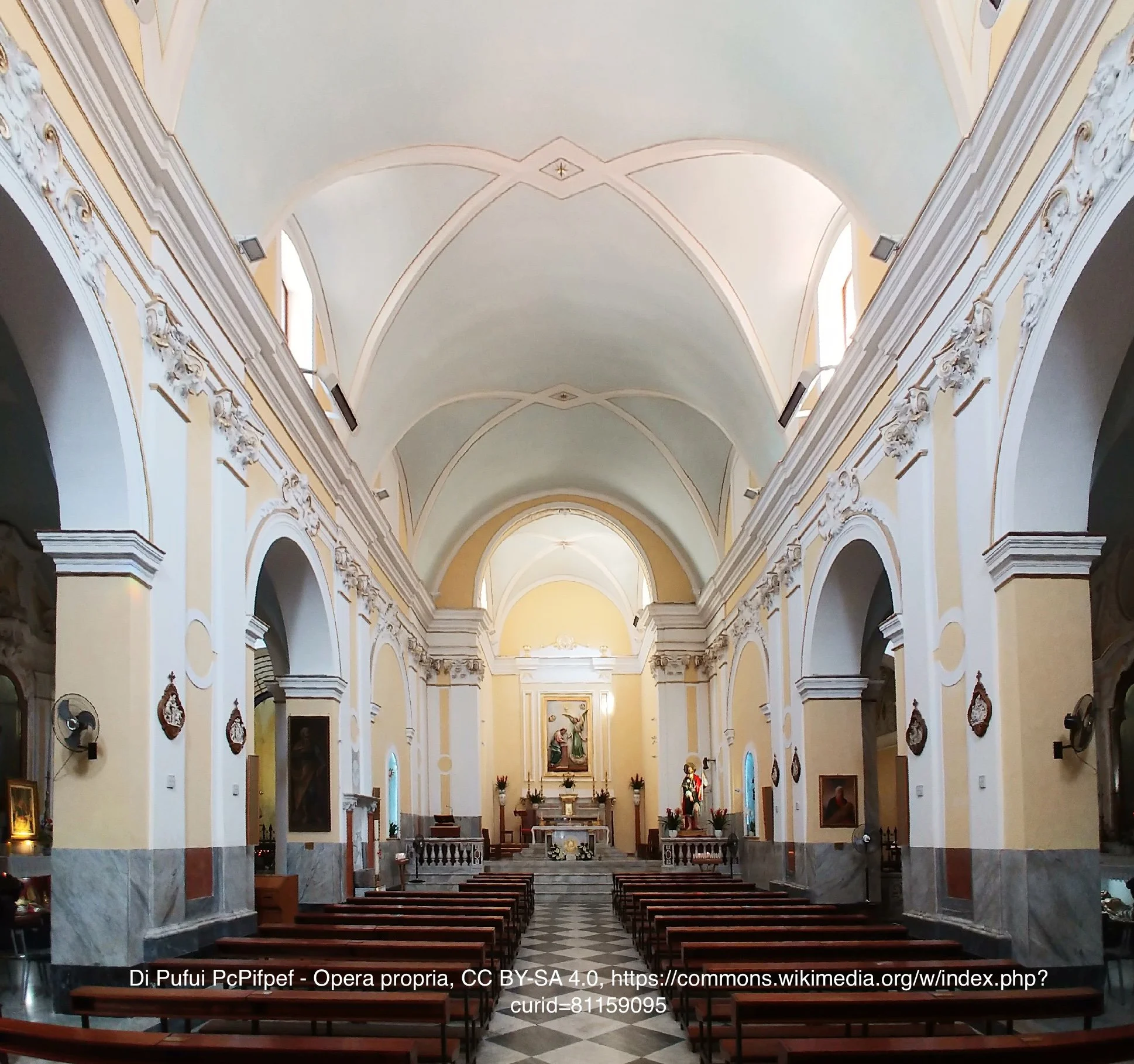
Elisabetta walked up to the big wooden door of the Santissima Annunziata, a church dedicated to the Annunciation. The light streamed in even though the afternoon light was beginning to fade. Some of the candles in the sconces on the sides of the church were lit, adding a bit of an ethereal glow to the church. It was her confirmation day.
Along with the others, she proceeded toward the front of the church and slowly approached the main altar. The black-and-white marble diamond pattern on the floor provided a path for her steps, past the stations of the cross on the side columns, the first seven stations on the right and then continuing with the second seven down the left side to the back of the church.
Elisabetta’s eye was drawn off to the side nave, and she rec-ognized the silver statue of Madonna della Cività. She loved the annual six-mile procession along the meandering road that wound its way through the Valle d’Itri into the Aurunci Mountains. The Sanctuary of the Madonna was on the peak of Mount Cività and from there, you could see in one direction the entire Gaeta peninsula and Ischia. In the other direction you could see Fondi and its coastal lakes and off in the distance, the Pontine Islands. From there, anything seemed possible. She recalled the frequently-told tale of the Madonna della Cività, repeated each year since the fifteenth century.
A deaf and mute shepherd found his lost cow at the base of an oak tree. Looking through the limbs of the tree, he saw a picture hanging of the Madonna. The Madonna in the picture smiled at him, and instantly he regained his speech. The sacred painting Madonna and Child was said to have been painted by St. Luke the Evangelist. It was believed to have been lost when the Byzantine Emperor Leo III ordered religious persecutions and outlawed sacred images. On the base of the icon, the three letters L.M.P. can be deciphered, even though badly faded. Some people say those initials stand for Lucas me pinxit, which is Latin for “Luke painted me.” A chapel was built on the spot and in 1492 the Bishop of Gaeta consecrated the first church that was to become the great Sanctuary of Cività.
And from out of nowhere, other words—words from Luke—crashed into her consciousness.
And in the sixth month the angel Gabriel was sent from God unto a city of Galilee, named Nazareth, to a virgin espoused to a man whose name was Joseph, of the house of David; and the virgin’s name was Mary. And the angel came in unto her, and said, Hail, thou that art highly favoured, the Lord is with thee: blessed art thou among women. And when she saw him, she was troubled at his saying, and cast in her mind what manner of salutation this should be. (Luke 1:26-29)
She knew that that prophecy for a teenage girl was not hers. It couldn’t be hers, and she blushed at the thought. But the nature of this greeting and the “favor” that followed had always preoccupied her. Worried her. What kind of a God issued these sorts of favors? She had always been both drawn to the stories of the saints, and at the same time, terrified by them. We each have some sort of destiny, she thought. What was hers?
As always, Elisabetta’s gaze settled upon a statue of the Madonna Addolerata, the Madonna of the Seven Sorrows. The eyes of the Madonna were cast toward the ceiling. The bleeding heart of the Madonna was pierced by seven daggers, each sym-bolizing a sorrow she would encounter in her life.
The Sorrows of the Madonna both captivated and tor-mented Elisabetta. The flight into Egypt. The loss of her child, Jesus, for three days. Meeting her son on his way to Calvary. His crucifixion and death. His removal from the cross and fi-nally his burial.
The seventh sorrow—and for Elisabetta the worst—was ac-tually the first one revealed to the Madonna. And this was the prophecy of Simeon that she would indeed have a life of sor-rows. A life of unanticipated sorrow would be bad enough in itself. But this was the truly heartbreaking sorrow: living with the foreknowledge of everything that was to come. She was cursed to know all the sorrows that would follow before any of them had even cast a shadow on her life. The Madonna’s worst sorrow of all was knowing her sorrows were inevitable, that they were her lot in life, that these sorrows were her destiny—and she accepted them anyway.
Like the “greeting” from Luke, this was another saintly “greet-ing” to be avoided, thought Elisabetta. All her life, Elisabetta had received greetings that she would rather have avoided. Mama worried about what she called Elisabetta’s moments. Elisabetta couldn’t quite explain them. Some of her moments were just that—she would wander off in her mind for a few minutes, forgetting where she was or what she was doing. These were the moments she could tell Mama about. But the others—the dark ones—she kept to herself. They came to her unbidden, and the best way she could describe them was as a shadow or a chill. They were not related to anything actually happening, but were tied to things that might happen. During these moments of dread, she was paralyzed, unable to describe exactly what would happen, only that she was certain something would and that she was helpless to stop it. Even now, standing in the confirmation procession, she could feel the shadows coming. She shook her head to ward them off.
But now she had a protector. She was so thankful that Rita of Cascia had come to her during the confirmation prepara-tions. Well, she had not actually come to her, thought Elisabetta, rather Elisabetta had sought her out. But then again, maybe Rita had come to her. When they were choosing their confirmation names—her namesake for confirmation, the patron saint whose name she would embrace as she received the sacrament—her eye had been drawn to the chapel on the side of the church, a small chapel for Saint Rita, the patron saint of the impossible and of hopeless circumstances.
She didn’t know Saint Rita’s full story before selecting her as her patron. Once she had selected Saint Rita without any advance thought, she became consumed with her story. This day of her confirmation was also the feast day for Saint Rita. It was surely an omen that this was the right choice.
Saint Rita had wanted to be a nun, but her parents had insisted she marry. The man her parents insisted she marry—Paolo Mancini—was cruel and harsh and ruled their home like a tyrant. She gave birth to two sons, and to protect them she steadfastly responded to her husband’s cruelty with kindness. He was murdered because of a rivalry between families, and her sons longed to avenge his death. She then prayed that her sons fail in this revenge, lest they too be condemned to eternal hell as the result of taking a life in anger. God took the sons in response—He allowed them to be killed—saving them from eternal damnation.
Such sadness, that a mother would pray for the death of her sons to save them from eternal damnation. Not really a very satisfactory response to prayer, Elisabetta thought.
After the death of her husband and sons, Rita was alone. Rita prayed once again that she might become a nun and enter a life of exclusion and isolation and contemplation. But she was re-jected again and again because the nuns were worried about the scandal surrounding the death of her husband and sons. The ful-fillment of her destiny to become a nun was achieved by agreeing to reconcile her family with her husband’s murderers as a condi-tion for joining the convent. Elisabetta marveled at all that it had taken for Rita to achieve her ultimate destiny as a nun.
At times Elisabetta wondered about what it might be like to be a nun, whether this would ultimately be her path. The idea of spending a life in prayer was appealing to her. When she would drift off, deep in her own thoughts, falling into crevices of thought that seemed to engulf her, she wondered wheth-er this was contemplation and prayer or merely an escape. In these moments, she had to consciously pull herself from the crevice, lest she sink deeper and deeper into it.
Thinking back to the fields of yellow that she saw upon en-tering the church, she suddenly recalled the opening lines to the great poet Giacomo Leopardi’s poem to the ginestra, lines that she had had to memorize in school. The words were from the Gospel of San Giovanni: “E gli uomini volevano oscurità piuttosto che luce” (And men wanted darkness rather than light).
As she gazed upon her family and friends in the pews, a dull monochrome darkness settled over all of them, especially around the young men. She suddenly sensed her own dark-ness descending. “Evitare l’oscurità” (Avoid the darkness), she prayed to herself.
The Latin of the Mass intruded upon her thoughts and the bishop began the familiar Kýrie, eléison.
Kýrie, eléison. (Lord have mercy)
Kýrie, eléison.
Kýrie, eléison.
But the shadows continued to invade her thoughts. It cer-tainly was a sign of darkness ahead, the advance awareness of trouble for them—death for some—as troubling as the knowl-edge itself.
Christe, eléison. (Christ Have Mercy)
Christe, eléison.
Christe, eléison.
She began to feel faint and shook her head again to clear the shadows. She prayed to her new guardian Rita for deliver-ance as the bishop concluded:
Kýrie, eléison. Kýrie, eléison. Kýrie, eléison.
The loud questions from the bishop—and his sudden switch back to Italian—broke through her haze and she stead-ied herself.
“Rifiuti Satana e tutte le sue opere e tutte le sue vuote promesse?” (Do you reject Satan and all his works and all his empty promises?)
“lo voglio.” (I do.)
“Credi in Dio Padre onnipotente, creatore di cielo e terra?” (Do you believe in God the Father almighty, creator of heaven and earth?)
“lo voglio.”
“Credi in Gesù Cristo, il suo unico Figlio, nostro Signore, che nac-que dalla Vergine Maria, fu crocifisso, morì e fu sepolto, risuscitato dai morti e ora è seduto alla destra del Padre?” (Do you believe in Jesus Christ, his only Son, our Lord, who was born of the Virgin Mary, was crucified, died, and was buried, rose from the dead, and is now seated at the right hand of the Father?)
“lo voglio.”
“Credi nello Spirito Santo, il Signore, il donatore di vita, che è venuto sugli apostoli a Pentecoste e oggi ti è dato sacramentalmente in conferma?” (Do you believe in the Holy Spirit, the Lord, the giver of life, who came upon the apostles at Pentecost and today is given to you sacramentally in confirmation?)
“lo voglio.”
“Credi nella santa chiesa cattolica, nella comunione dei santi, nel perdono dei peccati, nella risurrezione del corpo e nella vita eter-na?” (Do you believe in the holy catholic Church, the commu-nion of saints, the forgiveness of sins, the resurrection of the body, and life everlasting?)
“lo voglio.”
“Questa è la nostra fede Questa è la fede della Chiesa. Siamo or-gogliosi di professarlo in Cristo Gesù nostro Signore.” (This is our faith. This is the faith of the Church. We are proud to profess it in Christ Jesus our Lord.)
Before she knew what was happening, they were all kneel-ing at the front of the church. The bishop stood over her, mak-ing the sign of the cross on her head in chrism. He switched back to Latin:
“Elisabetta, Rita de Cascia, Et litterae signatae ipsius dona Spiritus sancti.” (Be sealed with the gifts of the Holy Spirit.)
And the traditional slap, a reminder to be brave: “Pax tecum.” And it was done. She drifted out of the church after the service in a bit of a haze, as usual consumed and a bit over-whelmed by the mysteries of her faith. She was thankful that Rita was now with her and was grateful for her intercession.
Without Rita, she feared she might sink beneath the burden of the Sorrows of the Madonna.
The rest of her day was predictable. A meal with the family and friends. And gifts for her. But nothing from her parents. After the guests had left, Mama and Papa pulled her aside.
“Elisabetta, we have something for you.” Her mother carefully handed her a beautiful wooden box in the shape of a book. Around the edges on the top of the box was an inlaid design in alternating patterns of red and black, and in the center was a tiny carving. Elisabetta carefully examined the carving. Two small hands hung from a cross.
“The hands symbolize Rita’s struggles and her lost sons,” said Mama. “May you have her faith but not her troubles.” And she crossed herself.
“There is a trick to the box,” said Papa. He took the box and showed her how to work it. The center of the box slid out to reveal a compartment big enough for a book. And in the compartment was her own New Testament.
“It is a safe place,” Papa whispered. “A place for you.”
She was touched at the thought her parents had put into this gift. A commemoration that she would not forget, and that she would never allow to be far from her. A celebration of her confirmation. A place of refuge and safety.
Grateful for the thoughtfulness of her parents and over-whelmed by the day, Elisabetta said a short prayer. Oh glorious St. Rita, who didst miraculously participate in the sorrowful Passion of our Lord Jesus Christ, obtain for me the grace to suffer with resig-nation the troubles of this life, and protect me in all my needs. Amen.
——-
This is the FIFTH of a series of Excerpts from Immigrant Secrets, the story of how I solved the mystery of my lost grandparents, Francesco and Elisabetta.
It would make a great holiday gift for someone who is interested in history or genealogy or really anyone who just likes a good mystery. I hope you’ll give the book a look.
Purchase link - https://www.amazon.com/Immigrant-Secrets-Search-My-Grandparents/dp/B0B45GTTPP.